Methodology

For the sixth consecutive year, Proximus NXT and Proximus NXT Luxembourg conducted an extensive cybersecurity survey in order to gain insight into the current situation and the concerns of their customers. The survey was conducted from mid-January to mid-March 2025 and yielded responses from 193 participants.

Survey design

The survey captured a wide range of data on our customers’ cybersecurity practices, challenges, and perceptions. It included both quantitative and qualitative questions in order to provide a holistic view.

Questionnaire development
Quantitative questions included multiple choice, Likert scale ratings and numerical input fields, aimed at collecting measurable data on various aspects such as the number of cyber incidents, types of incidents, budget allocation, etc. Qualitative, open-ended questions enabledrespondents to provide detailed insights.

Survey distribution
We distributed the final version of the survey through various channels, including email invitations and direct approaches by our sales teams.

Data collection period

The data collection period lasted two months – from mid-January to mid-March – to give respondents time to participate. We sent regular reminders to encourage participation.

Demographic distribution

Origin
89% of the 193 respondents operate in Belgium and 9% in the Grand Duchy of Luxembourg.
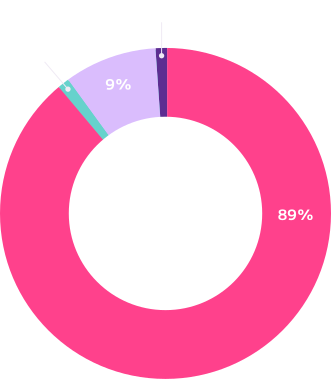
Waar werken de respondenten?
89 % België 
1 % Nederland 
9% Groothertogdom Luxemburg 
1/ Elders

Where do the respondents work?

Belgium
The Netherlands
The Grand Duchy of Luxembourg
Elsewhere

Company roles
Most respondents hold a managerial role. IT managers are the most strongly represented at 35%.

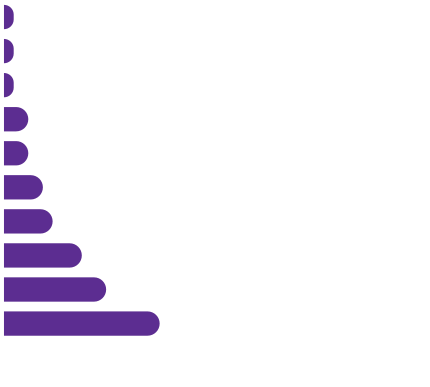
1% - Chief Risk Officer 1% - Chief Compliance Officer  2% - Data Protection Officer  5% - IT Security Officer (ITSO)  5% - Chief Financial Officer (CFO)  8% - Chief Information Officer (CIO)  10% - External Consultant 16% - Chief Information Security Officer (CISO) 21% - Chief Executive Officer (CEO) / Owner  32% - IT Manager 1% - Chief Risk Officer 1% - Chief Compliance Officer  2% - Data Protection Officer  5% - IT Security Officer (ITSO)  5% - Chief Financial Officer (CFO)  8% - Chief Information Officer (CIO)  10% - External Consultant 16% - Chief Information Security Officer (CISO) 21% - Chief Executive Officer (CEO) / Owner  32% - IT Manager

Company size
IT decision-makers from companies of varying sizes gave their views. 33% of companies had at least 250 employees.
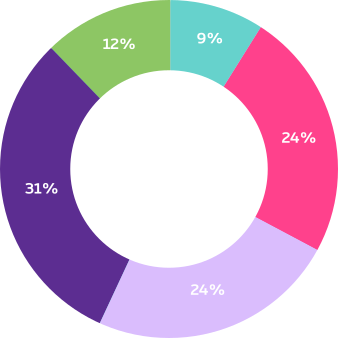
Number of company employees

> 2000
250 - 2000
50 - 249
10-49
< 10

Sectors

Numerous sectors were represented in the survey.
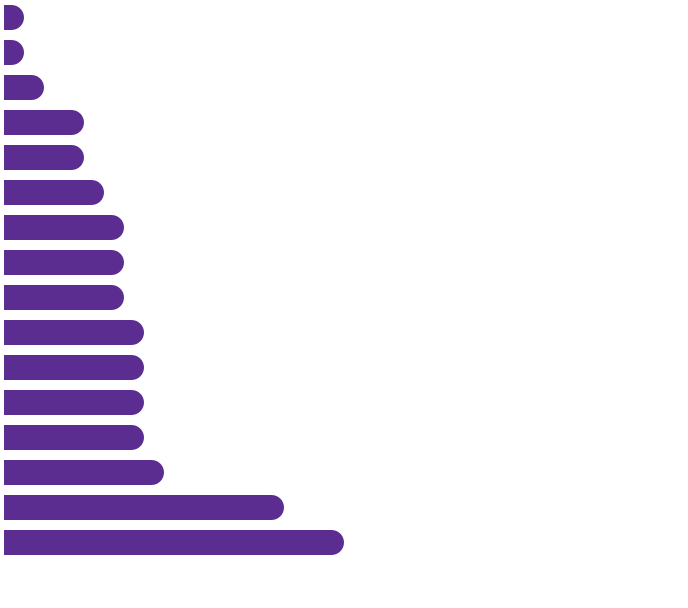
1% - Chief Risk Officer 1% - Chief Compliance Officer  2% - Data Protection Officer  5% - IT Security Officer (ITSO)  5% - Chief Financial Officer (CFO)  8% - Chief Information Officer (CIO)  10% - External Consultant 16% - Chief Information Security Officer (CISO) 21% - Chief Executive Officer (CEO) / Owner  32% - IT Manager

Data analysis

Quantitative analysis

  • We used statistical methods to analyze the numerical data gathered. As well as averages and percentages, they also included identifying trends and patterns in the responses.
  • Figures and diagrams give a graphic representation of the responses and make it easier to interpret the information and draw conclusions.

Qualitative analysis

  • We categorized the results so as to identify common themes and insights.
  • Qualitative data provide a deeper insight into the respondents’ experiences and perceptions and complement the quantitative findings.